
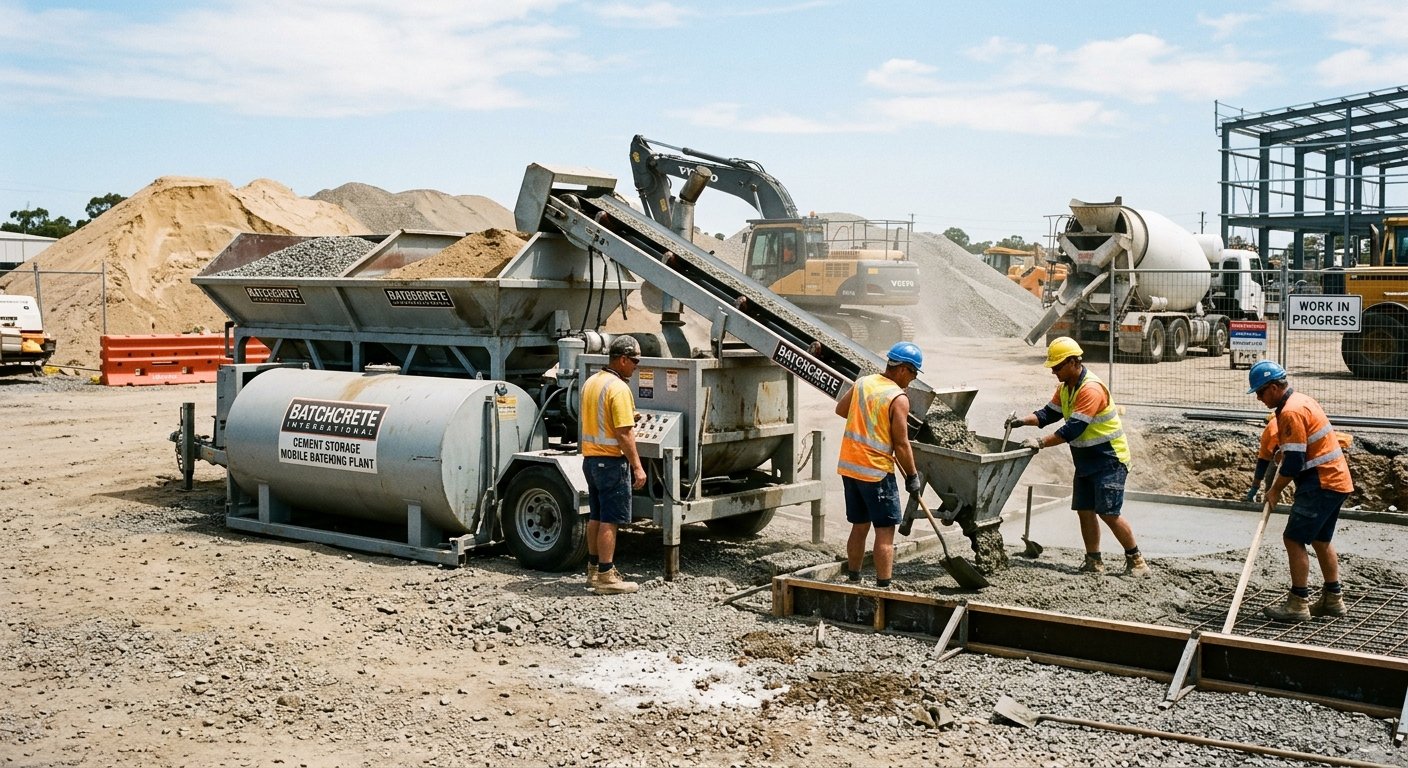
Concrete shortages are hitting Sydney job sites harder than most people admit out loud.
Sydney contractors are switching to mobile batch plants because producing concrete right at the job site removes the biggest risk in any pour, the truck. A mobile concrete batch plant cuts transport costs, stops delivery delays before they start, and gives you full control over mix quality and timing. On projects pouring more than 50m³ a week, most contractors see the switch pay for itself within a couple of months.
We built our Mobile Batch Plant range because we kept seeing the same thing happen, over and over. Good crews standing around, waiting on a truck that never showed up on time.
I’m breaking down the truth about mobile batching plants versus ready mix delivery, the real math behind hiring a cement silo instead of buying one, and why “just book more trucks” is actually bad advice.
Key Takeaways
- A mobile concrete batch plant removes ready mix delivery delays by producing concrete directly on the job site.
- On-site batching lowers per cubic metre costs by cutting transport and fuel expenses.
- Dry batch plants work especially well on remote sites where water and power access are limited.
- Government and infrastructure projects are driving strong demand for mobile batching equipment across Australia.
What’s Really Causing Concrete Delays in Sydney?
Everyone points to labour shortages or material costs. Both are real. But they’re not the main thing wrecking your Thursday pour.
It’s timing. Ready mix suppliers can only control the batch. Once that truck leaves the plant, traffic takes over. A load can sit in the drum too long on the way to site, and by the time it arrives, it’s already losing workability.
The Coordination Problem Nobody Talks About
Booking a ready mix delivery sounds simple until two things go wrong at once. The truck runs late, and your crew isn’t ready to pour the second it arrives. I’ve seen this happen because two site teams booked the pump and the truck on separate schedules, each assuming the other had it sorted. Nobody did.
Here’s a quick example. Contractors using Batchcrete International’s mobile batch plants in Sydney simply stop planning around traffic. There’s no delivery window to hit. No juggling the truck and the pump at the same time. Water, cement, and aggregate go straight into the mix right where the pour is happening.
How Much Does On-Site Concrete Batching Actually Save?
Run through this checklist before you decide if switching makes sense for your next job:
- Work out your weekly pour volume. Projects pouring over 50m³ a week usually see the equipment pay for itself fast.
- Add up your hidden delay costs. One late truck rarely costs you just one delay. It costs you re-pours, extra hand finishing, and idle crew time, all stacked on top of each other.
- Check your site access. Remote construction sites, mining projects, and infrastructure jobs with rough roads benefit the most from producing concrete on-site.
- Factor in fuel. Less concrete travelling on trucks means lower fuel costs and fewer trips overall.
- Compare it to rising costs. Construction costs across Sydney are forecast to climb around 4 per cent in 2026 as major projects compete for labour and contractor capacity. A self contained batching plant is one of the few costs you can actually manage yourself.
Is Mobile Batching Only Worth It for Big Infrastructure Jobs?
Here’s the part most people get wrong. No, it isn’t. And that assumption is quietly costing smaller contractors money.
Most people picture a modular concrete plant on a massive freeway job or a mine site. Fair enough, that’s where the equipment started. But that’s not where demand is growing fastest anymore.
- Commercial builders
- Residential developers running multi-lot subdivisions
- Civil contractors on mid-sized road construction jobs
They’re all adopting the same portable batching system for the same reason. Predictability beats scale, every single time.
Because here’s the thing nobody says out loud. A stationary concrete batching plant doesn’t care about your schedule. It cares about its own production run. Your job is just one of many on their board that day.
Mobile Batch Plant vs. Ready Mix Delivery
| Factor | Mobile Batch Plant | Ready Mix Delivery |
| Delay risk | Low, concrete is made on-site | High, depends on traffic and truck scheduling |
| Cost control | You control mix timing and volume | Fixed by supplier pricing and availability |
| Best suited to | Remote sites, infrastructure projects, long-running jobs | Small, easy-access, one-off pours |
| Site requirements | Needs space for a cement silo and aggregate bins | Needs clear truck access |
The Numbers Behind the Shift
The mobile concrete batch plant market size was estimated at USD 2.7 billion in 2024 and is set to reach USD 3.9 billion by 2034, growing at a CAGR of 3.9% from 2025 to 2034, according to GMI Insights. That’s not hype. That’s contractors putting real money behind on-site production.
Closer to home, Infrastructure Australia’s 2025 Infrastructure Market Capacity Report reveals the nation’s five-year Major Public Infrastructure Pipeline has grown $29 billion over the past year to reach $242 billion, according to the full report. At the same time, the industry is currently short of 141,000 workers needed to deliver the five-year pipeline.
Infrastructure Australia CEO Adam Copp put it plainly: “This added demand will not come without challenges for the market; productivity growth remains sluggish, while worker shortages present a significant risk to the delivery of projects.”
When labour is this tight and the pipeline this big, every hour saved on-site starts to matter a lot more.
Frequently Asked Questions
1. Do I need a special permit to run a mobile batch plant in Sydney?
Usually yes. Check with your local council early, requirements change depending on the site and its size.
2. Can one plant handle both wet batch and dry batch production?
Some units can. Others are built for just one method. It depends on the model.
3. How fast can a mobile batch plant be set up on-site?
Most modular units are running within a day or two, depending on power access and site prep.
4. Does the supplier provide an operator, or do I run it myself?
Both options exist. Some hire deals include a trained operator, others are self-managed.
5. What happens to the plant once the job is finished?
It moves with you. That’s the whole point, it goes straight to your next site instead of sitting idle.
Your First Step
Stop guessing whether on-site batching is worth it. Pull your last three months of delivery dockets, add up every delay, and multiply that by your daily crew cost.
If that number stings, get in touch with Batchcrete International about a mobile batch plant for your next Sydney pour, before your next load gets stuck behind the same roadworks again.
