
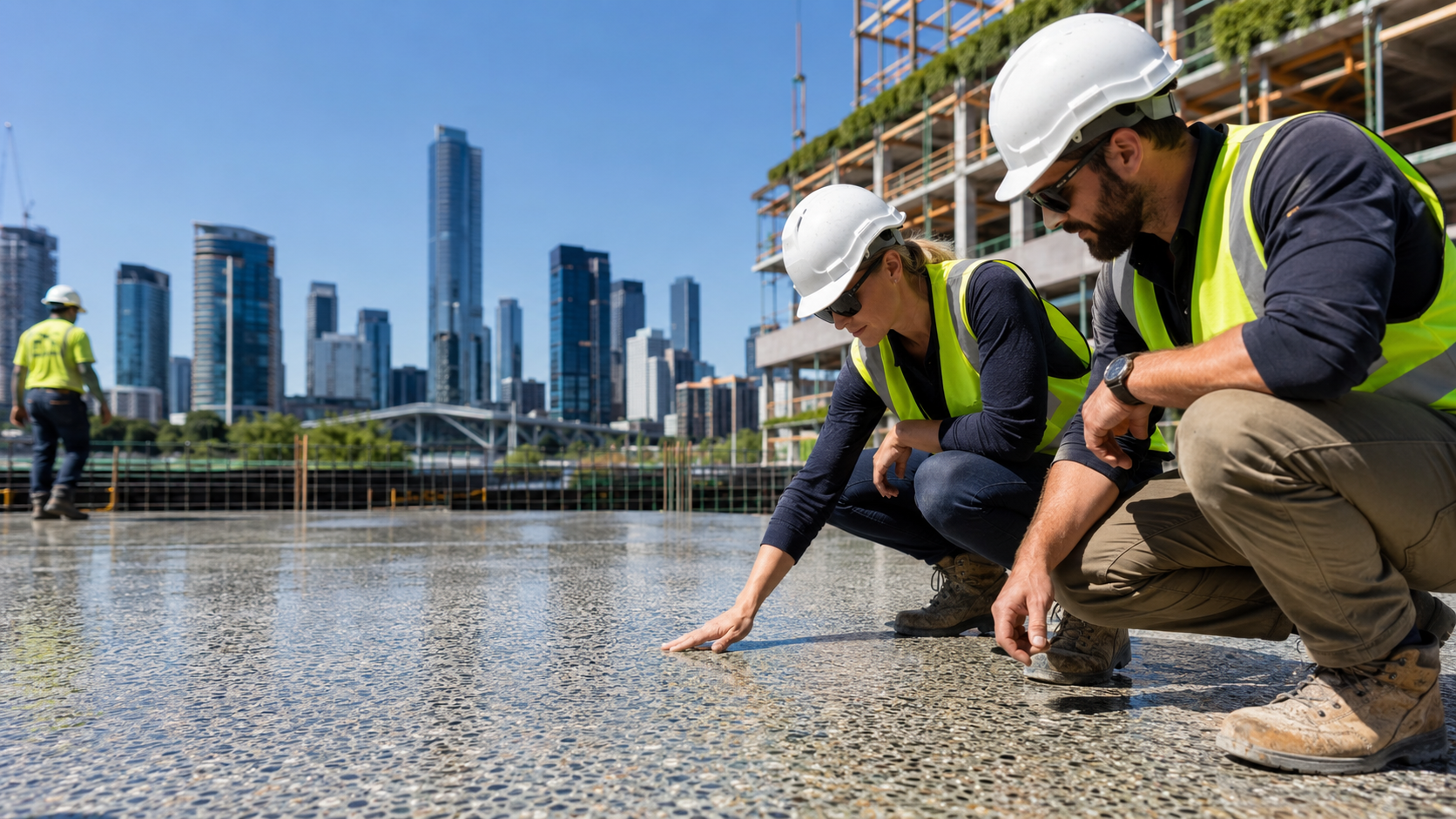
Right now, site managers across Queensland have tight budgets, strict project deadlines, and a massive fleet of heavy construction equipment to run.
But suddenly, the old way of doing things isn’t good enough anymore. New state rules mean you can’t just pour standard concrete and call it a day. You have to hit tough green targets while keeping your build structurally sound. It is a massive headache. And it is getting expensive if you get it wrong.
Brisbane builders aren’t going green because they love trees. They’re switching to low-carbon concrete because Queensland tenders now demand it, insurance costs less when you meet ESG targets, and clients won’t sign off without Environmental Product Declarations.
Low-carbon options like fly ash, slag cement, and geopolymer concrete cut embodied carbon by 40-70%. It’s not just eco-friendly concrete; it’s how you win contracts.
I’m breaking down what sustainable concrete in Australia actually means for your job sites, the real costs behind low carbon building materials, and why “too expensive” is based on old numbers that don’t apply anymore.
Key Points
- Sustainable concrete using fly ash and slag cement cuts carbon by 40-70% and matches or beats traditional concrete strength.
- Brisbane’s local fly ash and slag supply makes environmentally friendly concrete competitive on price, sometimes cheaper than traditional mixes.
- Queensland tenders now score carbon performance at 15-25% of total points, making low carbon concrete essential for winning work.
- Green Star certification and lower insurance costs pay back any sustainable concrete premium within 18-36 months.
Will Low-Carbon Concrete Hold Up on My Site?
Short answer: Yes.
I’ve worked on Brisbane construction sites for years, and this question comes up every time. Site managers think sustainable construction in Brisbane means weaker concrete. It doesn’t.
Geopolymer concrete can reach 70 MPa strength, which is stronger than most regular concrete. Studies show that fly ash geopolymer concrete lasts longer and is more durable than normal Portland cement.
Your Real Options Right Now
Here are some types of low-embodied-carbon concrete:
- Slag cement (30-50% replacement): Same strength, 35-40% less carbon
- Fly ash (20-35% replacement): 25-30% carbon reduction, good durability
- Geopolymer: 60-80% carbon cut, needs special mixing, great for precast
- Calcined clay: ~40% reduction, still being rolled out in Australia
These aren’t experimental. Australian universities and industry bodies have tested many batches. The strength is there.
What’s This Actually Going to Cost?
Let me give you real numbers.
Yes, some sustainable concrete mixes cost more upfront. Geopolymer might run $180-220 per cubic meter versus $150-170 for traditional. That’s real money.
But here’s what changed in 2024.
The Math That Actually Matters
Green Star buildings command 6.7% higher rental premiums (GBCA data). In Queensland government tenders, sustainability can make up 40-70% of your evaluation score, not just price.
One builder lost a major job last year because their concrete carbon numbers were too high. The winner used slag cement that cut embodied carbon by 42%.
You do the math on future bids.
Why Brisbane Is Different
This isn’t just about saving the planet. Brisbane’s got specific advantages.
We’ve got tons of fly ash from regional power stations. Gladstone cement works just spent $40 million on slag processing. These materials are here, available now, not shipped from overseas.
And Brisbane City Council? They now require embodied carbon reports for any development over 3,000 square meters. That started late 2023. It’s not optional.
What Embodied Carbon Actually Means
Most builders get this wrong. They think it’s just the mix design. It’s three things:
- Making the materials (cement production is the killer)
- Shipping everything (why local matters)
- What happens in 50 years (concrete actually absorbs some CO₂ over time)
A mix with 40% fly ash from Tarong Power Station beats “pure” concrete using cement from Asia. Just the shipping difference is 15-20% of total carbon.
Your supplier needs to give you an Environmental Product Declaration (EPD). No EPD? Find another supplier.
The Price Myth Everyone Believes
Here’s what changed that nobody’s talking about.
Regular Portland cement went up 22% since January 2023. Energy costs and carbon pricing hit manufacturers hard. But fly ash and slag? They’re byproducts from other industries. Prices stayed steady.
A Newstead builder I know just finished 180 apartments using 35% fly ash concrete. Came in 3% under budget compared to what traditional concrete would’ve cost.
The “green costs more” story? It’s outdated. Sometimes low carbon building materials are now the cheaper option.
Where to Use It First
You don’t need to go all-in immediately. Be strategic.
Start Here:
- Foundations and slabs (biggest volume, biggest carbon impact)
- Precast stuff (controlled production, perfect for geopolymer)
- Paths and kerbs (low-risk, good for testing new mixes)
- Fancy architectural concrete (only if the client demands it)
A commercial building foundation might use 2,000 cubic meters. Switch that to 40% slag cement? You’ve just cut the same carbon as taking 150 cars off the road. Every year. Just from the foundation.
The Net-Zero Reality
Brisbane can’t hit net zero construction by 2040 without fixing concrete first.
Think about it. Concrete is 60-75% of most building weight. You can’t offset 3,000 tons of high-carbon foundation with solar panels and timber framing. The numbers don’t work.
Every Brisbane project I’ve seen hit carbon neutral construction targets? They fixed the concrete first. Everything else is second.
Quick Comparison: What Works in Brisbane
| Concrete Type | Carbon Cut | Strength | Available Now? | Cost |
| Traditional | 0% | 32-40 MPa | Yes | $150-170/m³ |
| 30% Fly Ash | 25-30% | 32-45 MPa | Yes | $145-165/m³ |
| 40% Slag | 35-45% | 35-50 MPa | Yes | $160-180/m³ |
| Geopolymer | 60-80% | 40-70 MPa | Limited | $180-220/m³ |
Getting Through Queensland Compliance
If this is your first sustainable construction project, the paperwork feels overwhelming. Environmental Product Declarations, carbon intensity, emissions categories… it’s a lot.
What Green Star Actually Checks
I’ve done seven Green Star projects in 18 months. Here’s what they actually look at:
Your concrete EPD needs to show carbon intensity in kgCO2e per cubic meter. Queensland’s benchmark for “good” is under 300. Traditional concrete? Usually 320-380.
You need that drop to pass.
And they check everything. Your batching plant’s carbon accounting. How far materials traveled. Whether you used recycled water. I’ve seen projects delayed weeks because EPD paperwork was incomplete.
Frequently Asked Questions
1. Can I use low-carbon concrete on high-rise builds in Brisbane?
Yes. Projects like Queen’s Wharf used it, passed all QBCC inspections, and met AS 3600 structural codes without issues.
2. How much carbon does switching concrete actually save?
Using 40% slag cement typically cuts total project carbon by 15-25%, since concrete makes up 60-75% of building weight.
3. Does sustainable concrete work in Queensland’s climate?
Better than traditional concrete, fly ash and slag handle heat and humidity well, with less cracking and better sulfate resistance.
4. How fast can I get low-carbon concrete delivered?
Standard fly ash and slag blends? Same day from Boral and Holcim. Geopolymer needs 2-4 weeks notice.
5. Are there government rebates for using it?
Not direct rebates, but projects score higher on Queensland infrastructure tenders and may get faster Brisbane City Council approvals.
Final Words
Don’t wait until you’re mid-project. That costs money.
Here’s your move: Grab your next job’s concrete specs. Calculate total cubic meters for foundations and structure. Call your supplier and ask for EPDs; traditional mix versus 35% fly ash or slag at the same strength.
Look at the carbon numbers. Check the price difference. Then think about how this helps you score higher on your next tender.
Because that’s the real win. Not just this project but every bid you submit.
Brisbane’s construction industry changed. The builders winning work right now aren’t doing sustainable concrete because it’s nice. They’re doing it because clients, insurers, and government tenders made it the new standard.
You can lead this change or scramble to catch up six months late. Your choice.
